
eGFR Calculator: Check Your Kidney Function
Enter the serum creatinine from your blood test report to estimate your GFR and kidney function stage, using the CKD-EPI 2021 equation.
Your eGFR
mL/min/1.73m²
Stage
Creatinine clearance
| Stage | eGFR | Kidney function |
|---|
This is a screening estimate, not a diagnosis. Kidney disease is diagnosed only when a low eGFR or kidney damage (such as protein in the urine) lasts for 3 months or more. eGFR is less accurate in pregnancy, for very muscular or very thin people, after an amputation, and during sudden illness. Always discuss your report with your doctor, and never change your medicines on your own.
Written by Dn. Aruba Rashid, certified dietitian (BS Human Nutrition and Dietetics). Updated October 2026.
What Is eGFR?
GFR, or glomerular filtration rate, is how much blood your kidneys filter every minute. It is the best overall measure of how well your kidneys are working. Because GFR is hard to measure directly, doctors estimate it from a simple blood test for creatinine, a waste product from your muscles, together with your age and sex. This estimate is called eGFR.
A healthy young adult usually has an eGFR of 90 or more. It falls slowly with age, so a value of 60 to 89 can be normal in older people if there are no other signs of kidney damage.
How to Use the eGFR Calculator
- Find serum creatinine on your blood test report (often in the renal function tests, RFTs or kidney function tests).
- Check the unit: most labs in Pakistan report creatinine in mg/dL. Some use µmol/L.
- Enter your age and gender, then press Calculate.
- Add your weight if you also want the creatinine clearance, which some doctors use to adjust medicine doses.
This calculator uses the CKD-EPI 2021 equation, the current recommended formula, which does not use race.
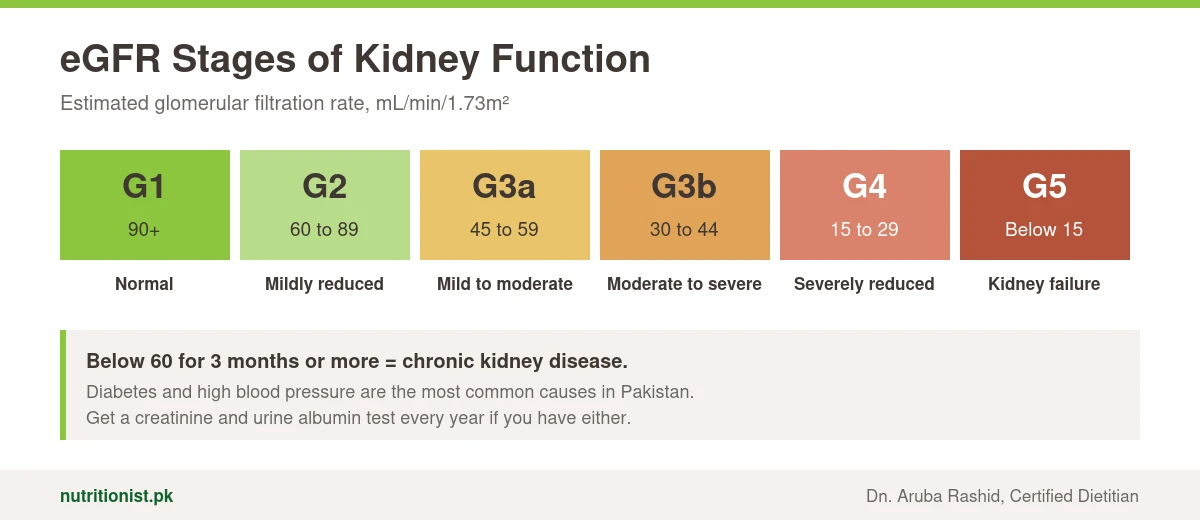
eGFR Stages of Kidney Function
| Stage | eGFR | What it means |
|---|---|---|
| G1 | 90 or more | Normal kidney function |
| G2 | 60 to 89 | Mildly reduced |
| G3a | 45 to 59 | Mild to moderately reduced |
| G3b | 30 to 44 | Moderately to severely reduced |
| G4 | 15 to 29 | Severely reduced |
| G5 | Below 15 | Kidney failure |
An eGFR below 60 for 3 months or more means chronic kidney disease (CKD). Stages G1 and G2 count as kidney disease only if there are also signs of damage, such as protein in the urine (shown as albumin or ACR on the report).
Who Should Check Their Kidney Function?
Kidney disease often causes no symptoms until it is advanced, so testing matters, especially if you have:
- Diabetes, which is the most common cause of kidney disease in Pakistan.
- High blood pressure.
- Heart disease or a family history of kidney disease.
- Frequent use of painkillers like ibuprofen or diclofenac.
- Repeated kidney stones or urine infections.
If any of these apply to you, ask your doctor for a creatinine test and a urine albumin test at least once a year.
Want a Diet Plan Made Just for You?
General plans are a good start, but your body, routine and health are unique. Dn. Aruba Rashid, certified dietitian, can create a personal plan for you online, anywhere in Pakistan.
Diet Tips to Protect Your Kidneys
Food plays a big part in slowing kidney disease. These tips suit most people, but if your eGFR is below 60, your diet should be planned with your doctor and a dietitian around your blood reports.
- Cut salt: keep it under 1 teaspoon (5 g) a day. Go easy on pickles, papad, namkeen, ready-made masalas and fast food.
- Control blood sugar: if you have diabetes, follow our diabetes diet chart and keep your HbA1c in your doctor’s target.
- Do not overdo protein: avoid protein powders and very high protein diets unless your doctor approves them. Normal portions of daal, chicken, eggs and dahi are fine for most people with early CKD.
- Watch potassium and phosphorus in later stages: foods like bananas, potatoes, tomatoes, dried fruit, cold drinks and processed cheese may need limits when eGFR is low. Your doctor will tell you if this applies to you.
- Drink enough water, unless your doctor has told you to limit fluids.
- Do not take herbal remedies or painkillers without asking your doctor.
Frequently Asked Questions
What is a normal eGFR?
An eGFR of 90 or more is normal. Between 60 and 89 is mildly reduced, which can be normal with age if there are no other signs of kidney damage.
What is a normal creatinine level?
For most adults, normal serum creatinine is about 0.6 to 1.1 mg/dL for women and 0.7 to 1.3 mg/dL for men. Your eGFR is a better measure than creatinine alone, because it adjusts for age and sex.
Can eGFR improve?
Sometimes. eGFR can be low for a short time because of dehydration, illness or some medicines, and it may go back up. In chronic kidney disease, controlling blood sugar and blood pressure and following a kidney-friendly diet can slow further decline.
Is eGFR 55 bad?
An eGFR of 55 is stage G3a, mild to moderately reduced kidney function. If it stays at this level for 3 months, it counts as chronic kidney disease. See your doctor to find the cause and plan follow-up tests.
What is the difference between eGFR and creatinine clearance?
Both estimate kidney function. eGFR uses the CKD-EPI equation and is used to stage kidney disease. Creatinine clearance uses the Cockcroft-Gault formula with your weight, and is often used to adjust medicine doses.
Get a Kidney-Friendly Diet Plan
A renal diet depends on your eGFR, potassium, phosphorus, sugar and blood pressure. Dn. Aruba Rashid, a certified dietitian, creates diet plans for diabetes, high blood pressure and early kidney disease using Pakistani food, working alongside your doctor’s advice. She consults online across Pakistan on WhatsApp, and sees women in person in Multan.