Uric Acid Diet: Foods to Eat, Avoid and a 7-Day Pakistani Chart
High uric acid is a very common result on blood tests in Pakistan, and many people are immediately told to stop eating daal, palak, tomatoes and even chicken. Much of that advice is outdated. This uric acid diet explains what really raises uric acid, which foods to limit, which foods can actually help, and gives you a simple 7-day Pakistani diet chart for high uric acid and gout.
Written by Dn. Aruba Rashid, certified dietitian (BS Human Nutrition and Dietetics). Updated October 2026.
Key takeaways
- Organ meat (kaleji, gurda, maghaz), red meat, seafood, sugary drinks and alcohol raise uric acid the most.
- Daal, palak and other plant foods are fine for most people in normal portions; studies do not link them to gout.
- Low-fat milk and dahi, plenty of water (2.5 to 3 litres a day) and slow weight loss help lower uric acid.
- For people with gout, doctors aim to keep uric acid below 6 mg/dL, often with medicine as well as diet.
- Keep taking your uric acid medicine as prescribed, and see a doctor for a hot, swollen joint.
What Is Uric Acid?
Uric acid is a natural waste product your body makes when it breaks down purines. Purines come from your own cells and from some foods, especially organ meats, red meat and seafood. Normally your kidneys remove uric acid in your urine.
When your body makes too much uric acid, or your kidneys do not remove enough, the level in your blood rises. This is called hyperuricaemia. Over time, high uric acid can form sharp crystals in the joints, causing gout, or in the kidneys, causing kidney stones.
Normal Uric Acid Levels
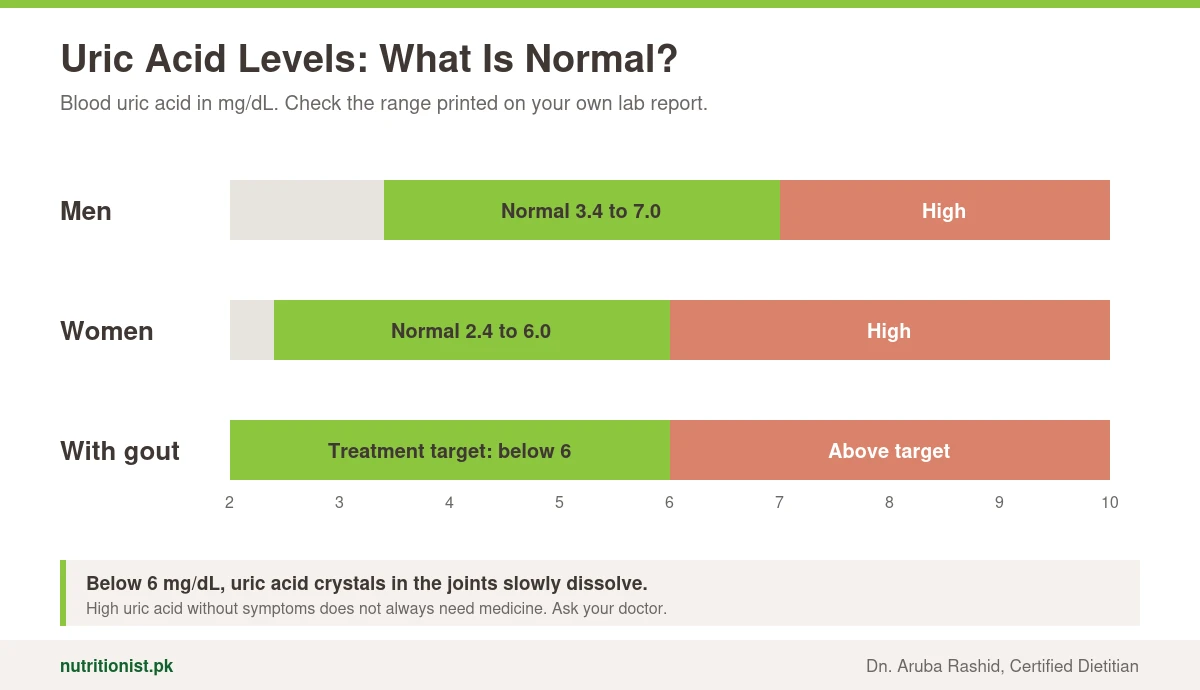
Normal ranges vary slightly between labs, but many labs use roughly these values:
| Group | Usual normal range | What it means |
|---|---|---|
| Men | About 3.4 to 7.0 mg/dL | Above 7.0 is usually called high |
| Women | About 2.4 to 6.0 mg/dL | Above 6.0 is usually called high |
| People with gout | Target below 6.0 mg/dL | The level doctors aim for with treatment |
For people with gout, the American College of Rheumatology recommends keeping uric acid below 6 mg/dL with treatment, because crystals slowly dissolve below this level. (Source: Arthritis Foundation, on the 2020 ACR gout guideline)
Always read your result alongside the range printed on your own lab report, and discuss it with your doctor.
What Causes High Uric Acid?
- A diet high in organ meats (kaleji, gurda, maghaz), red meat and seafood.
- Sugary drinks, packaged juices and other foods high in fructose.
- Being overweight, especially with belly fat.
- Diabetes, high blood pressure, high cholesterol and fatty liver.
- Kidney disease, which reduces how much uric acid is removed.
- Some medicines, such as water tablets (diuretics) and low-dose aspirin.
- Not drinking enough water, crash diets and long fasts.
- Alcohol, especially beer.
- Family history: high uric acid and gout often run in families.
What Is Gout?
Gout is a painful type of arthritis caused by uric acid crystals in a joint. It often starts suddenly at night, most commonly in the big toe, with severe pain, swelling, redness and warmth. It can also affect the ankle, knee, wrist or fingers.
If you think you are having a gout attack, see a doctor. Gout needs proper treatment, and a hot, swollen joint can also be caused by an infection, which needs urgent care.
Can Diet Lower Uric Acid?
Diet helps, but it is usually not enough on its own. Changing your diet may lower uric acid modestly and can reduce how often gout attacks happen, especially when combined with weight loss and enough water. Many people with gout also need medicine, such as allopurinol or febuxostat, to bring their level below 6 mg/dL.
If your doctor has prescribed uric acid medicine, keep taking it even when you feel well, and do not stop it during an attack unless your doctor tells you to. Diet works alongside your medicine, not instead of it.
Do You Really Need to Avoid Daal and Palak?
This is the most common worry in Pakistan. A large study that followed more than 47,000 men for 12 years found that people who ate the most meat had about a 41% higher risk of gout, and those who ate the most seafood had about a 51% higher risk. Purine-rich vegetables such as spinach, peas, beans and lentils were not linked to gout, and dairy was linked to a lower risk. (Source: Choi et al., New England Journal of Medicine 2004)
- Daal, chana, lobia, palak, mushrooms, gobi and peas are fine for most people in normal portions.
- If you have frequent gout attacks, keep portions moderate (about 1 bowl of daal a day) and see how your body responds.
- The bigger problems are organ meat, large amounts of red meat, seafood and sugary drinks.
Uric Acid Diet: 8 Rules That Work
1. Avoid organ meats
Kaleji (liver), gurda (kidney), maghaz (brain), paye stock and other organ meats are the richest sources of purines. Avoid them completely if you have gout or very high uric acid.
2. Limit red meat and seafood
Keep mutton and beef to small portions, no more than 2 to 3 times a week. Limit prawns, sardines, mackerel, anchovies and fish roe. Chicken and most white fish are better choices in moderate portions.
3. Cut sugary drinks and fructose
Cold drinks, packaged juices, energy drinks and sweets made with lots of sugar raise uric acid. Even fresh fruit juice adds a lot of fructose; eat whole fruit instead.
4. Drink plenty of water
Aim for 2.5 to 3 litres of water a day, unless your doctor has told you to limit fluids. Water helps your kidneys remove uric acid and lowers the risk of kidney stones. Keep a bottle with you, and drink more in hot weather.
5. Have low-fat dairy every day
Low-fat milk, dahi and lassi without sugar are linked to lower uric acid and fewer gout attacks. Aim for 1 to 2 servings a day.
6. Lose weight slowly
Losing extra weight lowers uric acid, but crash diets and very long fasts can raise it for a while and trigger attacks. Aim for 0.5 to 1 kg a week. See our calorie deficit diet plan for a safe approach.
7. Avoid alcohol
Alcohol, especially beer, raises uric acid and can trigger gout attacks. The safest choice is none.
8. Coffee and vitamin C can help a little
Some studies suggest regular coffee drinkers have lower uric acid, and that vitamin C from fruit such as guava, oranges and amla may help slightly. Neither replaces medicine, but unsweetened coffee and vitamin C-rich fruit are good additions.
Foods to Eat and Avoid with High Uric Acid
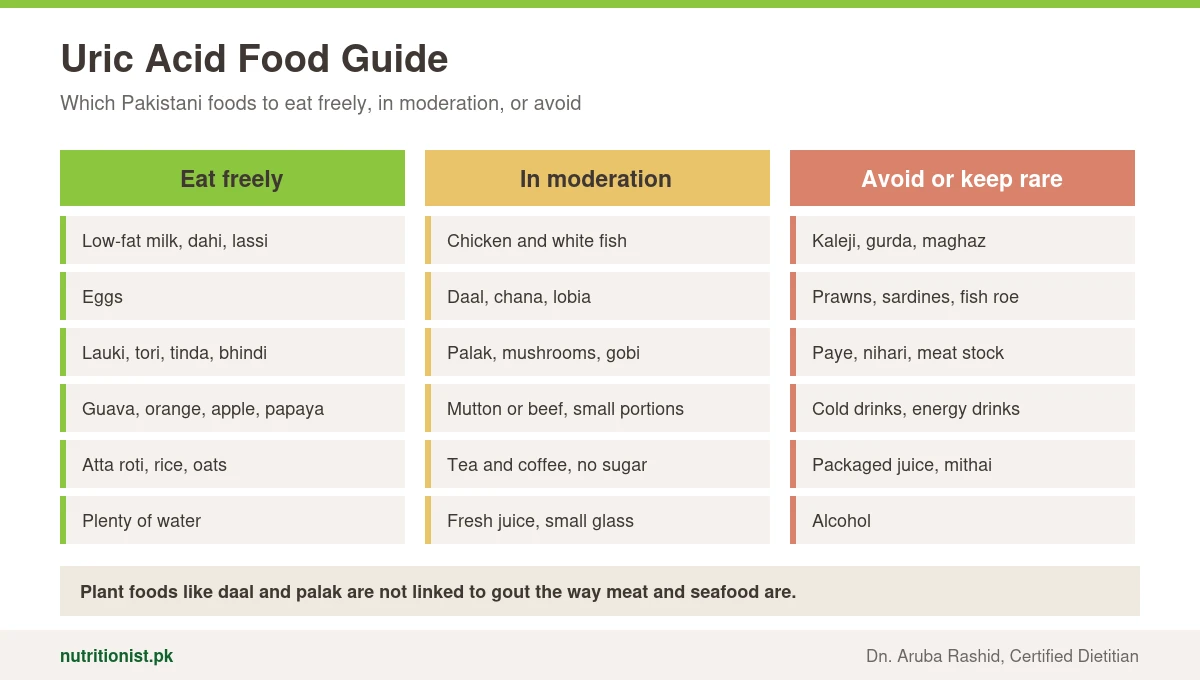
| Eat freely | Eat in moderate portions | Avoid or keep rare |
|---|---|---|
| Low-fat milk, dahi, lassi without sugar | Chicken and white fish | Kaleji, gurda, maghaz and other organ meat |
| Eggs | Daal, chana, lobia, rajma | Prawns, sardines, mackerel, fish roe |
| Sabzi: lauki, tori, tinda, karela, bhindi | Palak, mushrooms, gobi, peas | Large portions of mutton and beef |
| Fruit: guava, orange, apple, papaya, cherries | Mutton or beef, small portions | Cold drinks, energy drinks, packaged juice |
| Atta roti, rice, oats, daliya | Tea and coffee without sugar | Mithai and sweets with lots of sugar |
| Nuts and seeds in small portions | Fresh fruit juice (small glass) | Alcohol and yeast extract |
| Plenty of water | Oil and ghee, 1 to 2 teaspoons per serving | Paye and meat stock, nihari and haleem often |
Want a Diet Plan Made Just for You?
General plans are a good start, but your body, routine and health are unique. Dn. Aruba Rashid, certified dietitian, can create a personal plan for you online, anywhere in Pakistan.
7-Day Pakistani Diet Chart for High Uric Acid
This plan is low in organ meat, red meat and sugar, and includes low-fat dairy every day. It gives roughly 1,500 to 1,800 calories, which suits most adults; reduce portions slightly if you need to lose weight. Drink 2.5 to 3 litres of water through the day.
| Day | Breakfast | Lunch | Evening snack | Dinner |
|---|---|---|---|---|
| Day 1 | 2-egg omelette with onion and tomato, 1 roti | Chicken salan (less oil), 1 roti, salad | 1 cup low-fat dahi, 1 guava | Lauki chana daal, 1 roti |
| Day 2 | Oats with low-fat milk and fruit | Vegetable pulao, raita, salad | 1 orange | Grilled white fish, sabzi |
| Day 3 | Besan chilla (2 small), mint chutney, lassi without sugar | Masoor daal, half a cup of rice, salad | Roasted chana, small handful | Tori or tinda, 1 roti, raita |
| Day 4 | 2 boiled eggs, 1 roti, cucumber | Chicken karahi (less oil), 1 roti, salad | 1 apple, green tea | Mixed sabzi, 1 roti, dahi |
| Day 5 | Daliya with low-fat milk | Bhindi, 1 roti, raita | 10 almonds | Chicken soup with sabzi |
| Day 6 | Egg bhurji, 1 roti | Lobia, half a cup of rice, salad | 1 cup dahi with cucumber | Karela or lauki, 1 roti |
| Day 7 | Chana chaat with lemon, low-fat milk | Mutton salan (small portion), 1 roti, salad | 1 bowl of papaya | Daal, sabzi, 1 roti |
To check your calories, use our calorie calculator or our Pakistani food calorie calculator.
What to Eat During a Gout Attack
- Rest the joint, keep it raised, and use a cold pack wrapped in a cloth for 15 to 20 minutes at a time.
- Drink extra water through the day.
- Avoid meat, organ meat, seafood, sugary drinks and alcohol completely until the attack settles.
- Keep meals simple: daal, sabzi, roti, rice, eggs, dahi and fruit.
- Take the medicine your doctor has prescribed for the attack, and do not stop your regular uric acid tablet unless your doctor advises it.
High Uric Acid with Other Conditions
High uric acid often comes with belly fat, diabetes, high blood pressure and fatty liver, and improving one often helps the others. See our guides on how to lose belly fat, our diabetes diet chart and our fatty liver diet plan.
Because your kidneys remove uric acid, it is a good idea to check your kidney function too. Our eGFR calculator can help you understand your creatinine result.
In Ramadan, long fasts without water can raise uric acid. Drink plenty of water between iftar and sehri, and avoid heavy meat dishes at iftar. Our Ramadan diet plan has healthy sehri and iftar ideas. If you have gout, ask your doctor whether fasting is safe for you.
Frequently Asked Questions
Is daal bad for uric acid?
For most people, no. Large studies found that purines from plant foods such as daal, beans and spinach do not raise the risk of gout the way meat and seafood do. Eat daal in normal portions, about 1 bowl a day, and reduce it only if you notice it triggers your attacks.
Can I eat chicken with high uric acid?
Yes, in moderate portions. Chicken has fewer purines than organ meat, red meat and most seafood. Keep it to about a palm-sized portion once a day, and avoid chicken liver and other organ meat.
Which fruits are good for uric acid?
Most whole fruits are fine. Guava, orange, amla, papaya, apple and cherries are good choices, and vitamin C-rich fruit may help slightly. Avoid packaged juices and limit fresh juice, because juice is high in fructose.
Can I eat eggs if my uric acid is high?
Yes. Eggs are low in purines and are a good source of protein for people with high uric acid or gout. One to two eggs a day are fine for most people.
Does lemon water reduce uric acid?
Lemon water without sugar is a healthy drink and helps you drink more water, which helps your kidneys remove uric acid. It will not cure high uric acid on its own, and you should not add sugar or honey to it.
How fast can I lower my uric acid with diet?
Diet changes may lower uric acid slowly over a few weeks to months, usually by a modest amount. If you have gout or a very high level, your doctor may prescribe medicine, which works faster and more strongly. Ask your doctor when to repeat your test.
Are tomatoes bad for gout?
Tomatoes are low in purines, and most people with high uric acid can eat them normally. A few people feel they trigger attacks. If you notice this, you can cut down, but there is no need for everyone to avoid them.
Get a Personal Uric Acid Diet Plan
Your diet should fit your uric acid level, kidney function, weight and other health conditions. Dn. Aruba Rashid, a certified dietitian, creates personal diet plans for high uric acid and gout with Pakistani food, working alongside your doctor’s treatment. She consults online across Pakistan on WhatsApp, and sees women in person in Multan.