Thyroid Diet Plan: Foods to Eat, Avoid and a 7-Day Pakistani Meal Plan
Thyroid problems are very common in Pakistan, especially among women. Many people are told they have an underactive thyroid after months of tiredness, weight gain, hair fall or irregular periods, and then hear a long list of foods they “must never eat”. Most of that list is not true. This thyroid diet plan explains what really helps, which foods to be careful with, how to time your thyroid tablet around Pakistani meals and chai, and gives you a simple 7-day meal plan.
Written by Dn. Aruba Rashid, certified dietitian (BS Human Nutrition and Dietetics). Updated October 2026.
Key takeaways
- No food can cure a thyroid problem; diet supports your medicine, energy and weight, so never stop your tablet without your doctor.
- Use iodised salt for everyday cooking, and avoid iodine or kelp supplements unless your doctor advises them.
- Take levothyroxine on waking with water, wait 30 to 60 minutes before breakfast, and keep milk, calcium and iron 2 to 4 hours away.
- Cooked gobi, cabbage and shaljam in normal amounts are fine; you do not need to avoid them.
- Once your thyroid levels are normal, a small calorie deficit, enough protein and daily walking help you lose weight.
What Does the Thyroid Do?
The thyroid is a small, butterfly-shaped gland in the front of your neck. It makes hormones (T3 and T4) that control your metabolism: how fast your body uses energy, your heart rate, body temperature, digestion, mood and periods.
When the thyroid makes too little hormone, it is called hypothyroidism (underactive thyroid). When it makes too much, it is hyperthyroidism (overactive thyroid). Hypothyroidism is far more common, and the most frequent cause is Hashimoto’s thyroiditis, where the immune system slowly damages the gland.
Hypothyroidism vs Hyperthyroidism
| Hypothyroidism (underactive) | Hyperthyroidism (overactive) | |
|---|---|---|
| Common signs | Tiredness, weight gain, feeling cold, dry skin, hair fall, constipation, heavy or irregular periods | Weight loss, feeling hot, fast heartbeat, shaky hands, anxiety, loose motions, poor sleep |
| Blood test | High TSH, low or normal T4 | Low TSH, high T4 or T3 |
| Main treatment | A daily thyroid hormone tablet (levothyroxine) | Anti-thyroid medicines, radioactive iodine or surgery |
| Diet focus | Enough iodine and protein, weight control, correct tablet timing | Enough calories and protein, calcium for bones, less caffeine, no extra iodine |
Can Diet Cure a Thyroid Problem?
No. No food, tea or herb can cure hypothyroidism or hyperthyroidism, and you should never stop or change your thyroid medicine without your doctor. What a good diet can do is make sure your body has the nutrients the thyroid needs, help you manage your weight and energy, and help your medicine work properly by taking it at the right time.
Iodine and Iodised Salt in Pakistan
Your thyroid needs iodine to make its hormones. Iodine deficiency was once very common in Pakistan, especially in the northern areas, and it is still one reason for goitre (a swollen thyroid). The easiest way to get enough is to use iodised salt for everyday cooking.
- Check the packet says “iodised salt”, and keep it in a closed container away from heat and moisture.
- Other good sources are eggs, fish, milk and dahi.
- Do not take iodine tablets, kelp or “thyroid support” supplements unless your doctor advises it. Too much iodine can make some thyroid problems worse, especially Hashimoto’s and hyperthyroidism.
- You do not need extra salt. Use iodised salt in normal amounts, especially if you have high blood pressure.
How to Take Your Thyroid Tablet with Pakistani Meals
The timing of your tablet matters as much as your diet. Levothyroxine is absorbed best on an empty stomach, and some foods and supplements can block it. (Source: SingHealth, levothyroxine)
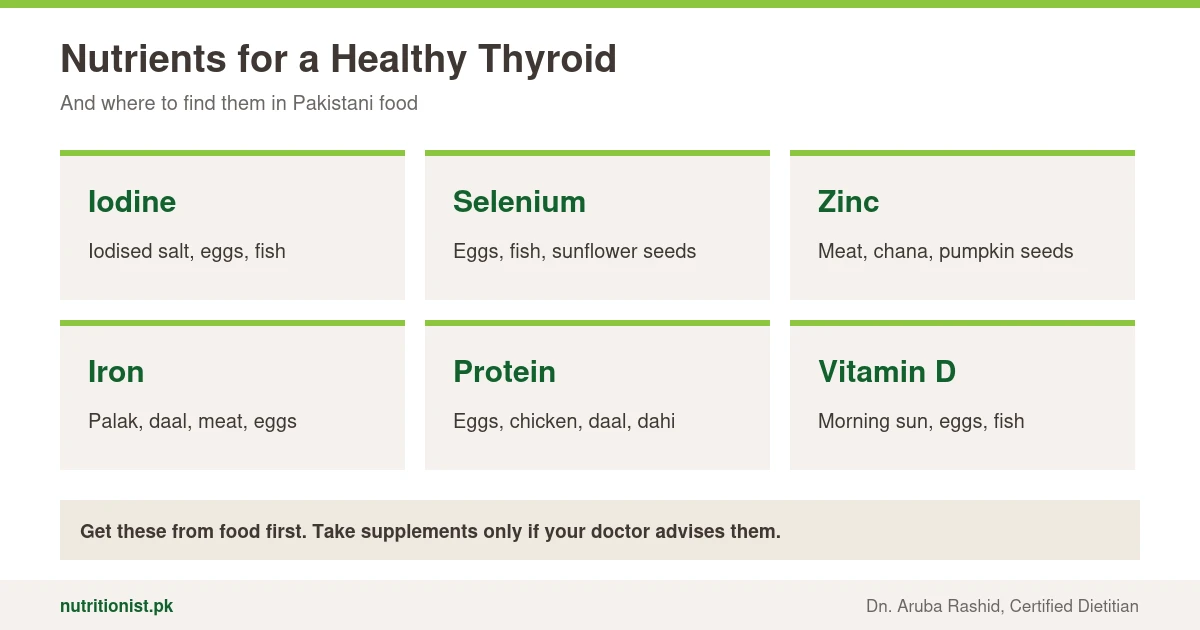
- Take your tablet first thing in the morning, with a glass of plain water.
- Wait at least 30 to 60 minutes before breakfast or chai.
- Keep milk, doodh patti, dahi and other dairy 2 to 4 hours away from the tablet if you can. A good habit is to have your doodh patti mid-morning rather than with breakfast.
- Keep calcium, iron and multivitamin tablets, and antacids, at least 4 hours away from your thyroid tablet.
- Take it at the same time every day. If you often forget, ask your doctor whether taking it at bedtime, at least 3 hours after dinner, could work for you.
In Ramadan, many people take the tablet at sehri or before iftar on an empty stomach. Ask your doctor which timing is best for you.
Nutrients Your Thyroid Needs
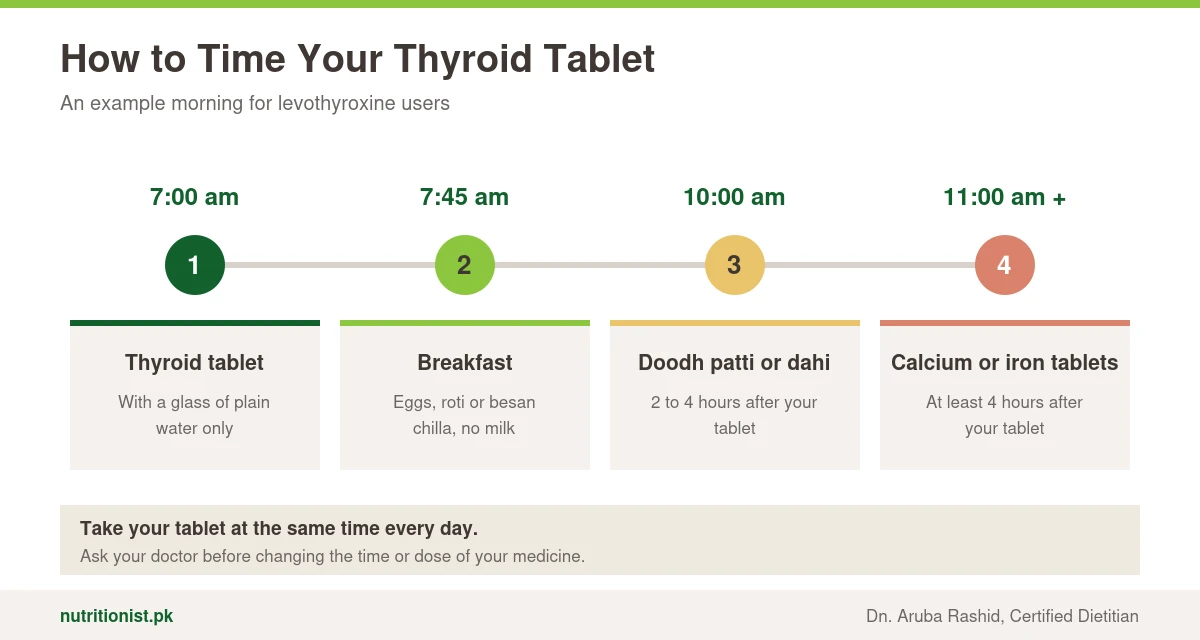
- Selenium: helps make and activate thyroid hormone. Found in eggs, fish, chicken, sunflower seeds and whole grains.
- Zinc: found in meat, chicken, chana, lobia, pumpkin seeds and nuts.
- Iron: low iron is common in Pakistani women and makes tiredness worse. Eat palak, daal, chana, meat and eggs, with lemon or fruit for vitamin C. Ask your doctor to check your iron (ferritin) if you are always tired.
- Vitamin D: many Pakistanis are low in vitamin D. Get some morning sun and ask your doctor about testing.
- Protein: eggs, chicken, fish, daal, dahi and paneer help you stay full and protect muscle while you manage your weight.
What About Gobi, Cabbage and Soya?
Cabbage (band gobi), cauliflower (phool gobi), broccoli, shaljam and soya contain natural substances called goitrogens, which can interfere with iodine use in very large amounts. This is why many people are told to avoid them. You do not need to. (Source: Aga Khan University Hospital)
- Cooking reduces goitrogens a lot, and Pakistani sabzi is almost always cooked.
- Normal portions, a few times a week, are fine for most people who get enough iodine.
- Avoid eating very large amounts of raw cabbage or drinking raw “green juices” every day.
- Soya can reduce how well your tablet is absorbed, so keep soya foods a few hours away from your tablet.
Thyroid Diet: Foods to Eat and Limit
| Eat regularly | Eat in normal amounts | Limit |
|---|---|---|
| Eggs, fish, chicken | Cooked gobi, band gobi, shaljam | Sugar, mithai and sweet chai |
| Daal, chana, lobia, rajma | Soya and tofu (away from your tablet) | Fried snacks: samosa, pakora, nimko |
| Sabzi: lauki, tori, palak, bhindi, tinda | Milk, dahi and paneer (away from your tablet) | Bakery items, white bread, biscuits |
| Fruit: guava, apple, orange, papaya, banana | Atta roti and rice in controlled portions | Fast food and processed meat |
| Nuts and seeds: sunflower, pumpkin, almonds | Tea and coffee (not with your tablet) | Iodine or kelp supplements without advice |
| Iodised salt in normal amounts | Ghee and oil, 1 to 2 teaspoons per serving | Very large amounts of raw cabbage juice |
Want a Diet Plan Made Just for You?
General plans are a good start, but your body, routine and health are unique. Dn. Aruba Rashid, certified dietitian, can create a personal plan for you online, anywhere in Pakistan.
7-Day Pakistani Diet Plan for Hypothyroidism
This plan gives roughly 1,400 to 1,600 calories a day, which suits most women who want to manage or lose weight. Take your tablet on waking, then have breakfast 45 to 60 minutes later. Breakfasts are kept dairy-free, and doodh patti is moved to mid-morning, to help your tablet work.
| Day | Breakfast (1 hour after tablet) | Mid-morning | Lunch | Evening | Dinner |
|---|---|---|---|---|---|
| Day 1 | 2-egg omelette with sabzi, 1 roti | Doodh patti, less sugar | Chicken salan, 1 roti, salad | 1 guava | Masoor daal, lauki, salad |
| Day 2 | Besan chilla (2 small), mint chutney | 1 cup dahi | Chana pulao (half a cup), salad | 10 almonds | Grilled fish, sabzi |
| Day 3 | 2 boiled eggs, 1 roti, cucumber | Doodh patti, 1 apple | Palak chicken, 1 roti | Roasted chana | Mixed daal, tori, 1 roti |
| Day 4 | Oats cooked in water with fruit and seeds | Lassi without sugar | Daal chawal (half a cup rice), salad | 1 orange | Chicken karahi (less oil), salad |
| Day 5 | Egg bhurji, 1 roti | Doodh patti, 2 walnut halves | Fish curry, half a cup of rice | 1 cup dahi | Lobia, 1 roti, salad |
| Day 6 | Chana chaat with 1 boiled egg | 1 banana, green tea | Gobi aloo (cooked), 1 roti, raita | Sunflower seeds, a small handful | Chicken soup with sabzi |
| Day 7 | 2-egg omelette, 1 brown bread slice | Doodh patti, 1 pear | Chicken biryani (1 small cup), raita | 1 apple | Daal, tinda, 1 roti |
Check your own daily calorie needs with our calorie calculator or TDEE calculator, and adjust portions if you are a man or very active.
How to Lose Weight with Hypothyroidism
An underactive thyroid slows your metabolism a little, but most of the weight gained before treatment is extra fluid. Once your thyroid levels are normal on medicine, you can lose weight in the same way as anyone else: a small calorie deficit, enough protein and regular activity.
- Get your TSH checked regularly so your dose stays right. Weight loss is much harder when levels are off.
- Eat about 300 to 500 calories less than your body needs. See our calorie deficit diet plan.
- Cut sugar in chai and cold drinks first; it is the easiest change.
- Walk daily and add strength exercise 2 to 3 times a week to protect muscle.
- Sleep 7 to 8 hours. Tiredness from thyroid problems makes cravings worse.
- If most of your weight is around the stomach, read our guide on how to lose belly fat.
Diet Tips for Hyperthyroidism
If your thyroid is overactive, you may lose weight without trying and feel hungry often. Until your levels are controlled:
- Eat enough calories and protein with 3 meals and 2 to 3 snacks, to stop muscle and weight loss.
- Include milk, dahi and other calcium foods, because an overactive thyroid can weaken bones.
- Cut down on tea, coffee and energy drinks, which can make a fast heartbeat and shakiness worse.
- Do not take iodine supplements or kelp, and follow your doctor’s advice on iodine before radioactive iodine treatment.
Thyroid, PCOS and Pregnancy
Thyroid problems and PCOS often appear together and have similar symptoms, such as weight gain, hair fall and irregular periods. If you have PCOS, ask your doctor whether your thyroid has been checked. Our PCOS diet plan works well alongside a thyroid diet.
In pregnancy, your body needs more thyroid hormone, and your dose often has to be increased early. If you take thyroid medicine and are planning a pregnancy or are pregnant, tell your gynaecologist straight away and follow their advice. See our pregnancy diet plan for healthy eating during pregnancy.
Frequently Asked Questions
Which foods should thyroid patients avoid?
There are very few foods you must avoid completely. Limit sugar, fried snacks, bakery items and processed food, avoid iodine or kelp supplements unless your doctor advises them, and keep soya, milk and high fibre foods away from the time you take your tablet. Cooked gobi and cabbage in normal amounts are fine.
Can I drink chai if I have a thyroid problem?
Yes. Just do not have it with your tablet. Take your thyroid tablet with water, wait at least 30 to 60 minutes, and ideally have doodh patti 2 to 4 hours later, since milk can reduce absorption. Keep sugar low if you are trying to lose weight.
Is rice bad for thyroid patients?
No. Rice does not harm the thyroid. Keep portions to about half a cup to one cup per meal, and pair it with daal, chicken or sabzi, especially if you are managing your weight.
Can I eat cauliflower and cabbage with hypothyroidism?
Yes, cooked and in normal amounts. Cooking reduces the goitrogens in these vegetables, and they are only a concern in very large raw amounts or if you are low in iodine. Use iodised salt and you can enjoy gobi as part of a balanced diet.
What is the best breakfast for thyroid patients?
A breakfast eaten 45 to 60 minutes after your tablet, with protein and fibre and without milk, works well: for example an egg omelette with sabzi and 1 roti, or besan chilla with chutney. Have your doodh patti or dahi later in the morning.
Should thyroid patients take iodine or selenium supplements?
Not without your doctor’s advice. Most people in Pakistan get enough iodine from iodised salt, and extra iodine can make some thyroid conditions worse. Selenium is best taken from food such as eggs, fish and seeds unless your doctor recommends a supplement.
Does hypothyroidism make it impossible to lose weight?
No. Once your thyroid levels are in the normal range on medicine, you can lose weight with a small calorie deficit, enough protein and regular exercise. Weight loss may be a little slower, so focus on steady progress and regular TSH checks.
Get a Personal Thyroid Diet Plan
Every thyroid patient is different. Your plan should fit your test results, medicine timing, weight goal and routine. Dn. Aruba Rashid, a certified dietitian, creates personal thyroid diet plans with Pakistani food, working alongside your doctor’s treatment. She consults online across Pakistan on WhatsApp, and sees women in person in Multan.