How to Lose Belly Fat: 12 Proven Tips and a Pakistani Diet Plan
Belly fat is the most common weight complaint in Pakistan, for men and women alike. A tight shalwar or a waistband that no longer closes is often the first sign. But belly fat is more than a looks problem: fat stored deep around the stomach is closely linked to diabetes, high blood pressure, fatty liver and heart disease. This guide explains what really burns belly fat, what does not, and gives you a simple Pakistani diet plan and daily routine you can start today.
Written by Dn. Aruba Rashid, certified dietitian (BS Human Nutrition and Dietetics). Updated October 2026.
Key takeaways
- Belly fat cannot be burned on its own; you lose it by losing fat overall through diet and daily activity.
- For South Asians, a waist of 90 cm (35.4 in) or more in men and 80 cm (31.5 in) or more in women raises the risk of diabetes and heart disease.
- Cutting sugar in chai, cold drinks and juices is the single biggest change for most Pakistanis.
- Keep roti and rice, but in smaller portions, and fill half your plate with sabzi and salad, with protein at every meal.
- Walk 30 minutes a day, add strength training 2 to 3 times a week, and sleep 7 to 8 hours.
What Causes Belly Fat?
There are two kinds of belly fat. Subcutaneous fat sits just under the skin, the part you can pinch. Visceral fat sits deeper, around the liver, intestines and other organs, and it is the more harmful type. A large, firm belly usually means a lot of visceral fat.
The most common causes are:
- Eating more calories than you burn: extra calories from roti, rice, oil, mithai and snacks are stored as fat, and much of it settles around the waist.
- Sugar and sugary drinks: sweet chai, cold drinks, juices and desserts are strongly linked to belly fat.
- Sitting most of the day: desk jobs, long drives and evenings in front of the TV or phone.
- Poor sleep and stress: sleeping less than 6 hours and high stress both make it harder to lose fat and easier to overeat.
- Age and hormones: men tend to store fat on the belly, and many women gain belly fat after pregnancy and around menopause.
- Genes: South Asians tend to store more fat around the waist than many other groups, even at a normal body weight.
Why Belly Fat Is Risky for Pakistanis
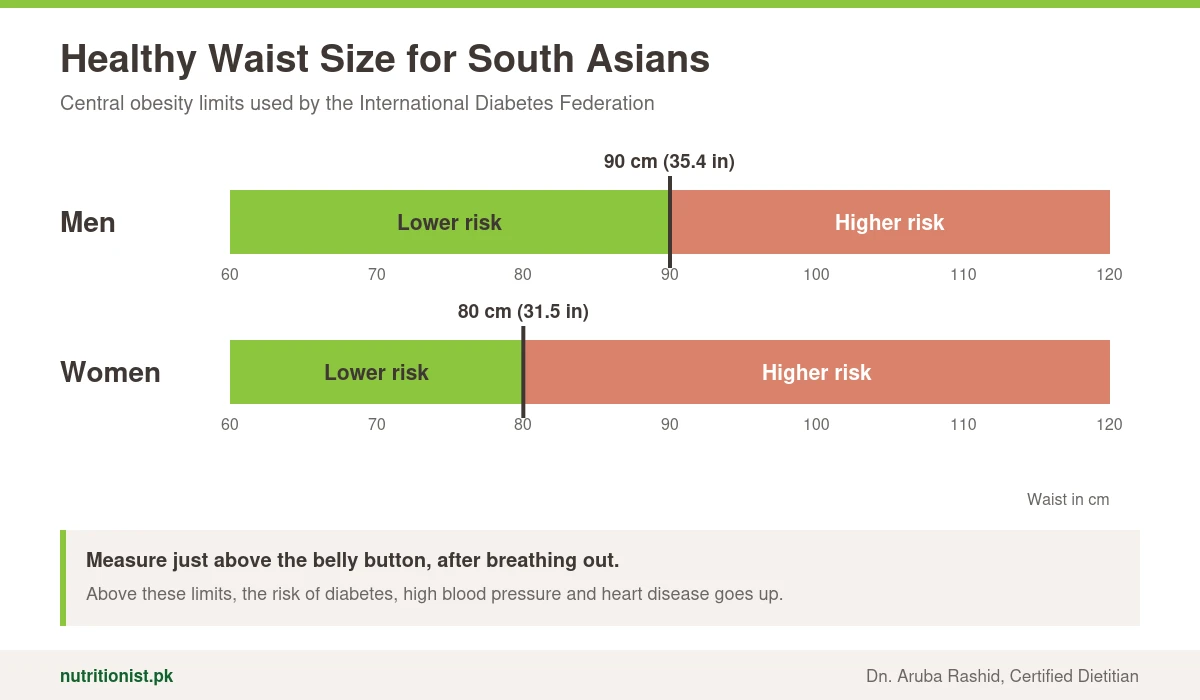
Because South Asians store more fat around the organs, health risks start at a smaller waist size. The International Diabetes Federation uses these waist limits for South Asians:
- Men: 90 cm (35.4 inches) or more means central obesity.
- Women: 80 cm (31.5 inches) or more means central obesity.
(Source: GPnotebook, waist measurement and obesity)
Above these numbers, the risk of type 2 diabetes, high blood pressure, high cholesterol and heart disease goes up, even if your BMI looks normal. That is why your waist size can tell you more than your weight.
How to Measure Your Waist Correctly
- Stand straight and breathe out normally.
- Find the top of your hip bone and the bottom of your ribs. Measure halfway between them, which is usually just above the belly button.
- Keep the tape snug but not pressing into the skin, and level all the way around.
- Measure in the morning, before eating, once every two weeks.
You can also check your body shape and waist-to-hip ratio with our body type calculator, and your body fat percentage with our body fat calculator.
Can You Lose Belly Fat Only?
No. You cannot choose where your body burns fat. Doing hundreds of crunches, wearing a belly belt or using a “fat burning” gel will not melt fat from the stomach alone. These may make your muscles stronger or make you sweat, but they do not burn fat in that spot.
The good news is that belly fat, especially visceral fat, is often among the first fat to go when you lose weight overall. Lose weight through diet and daily activity, and your waist will shrink. For most people, losing 5 to 10% of body weight brings a clear drop in waist size and real health benefits.
12 Proven Ways to Lose Belly Fat
1. Eat in a small calorie deficit
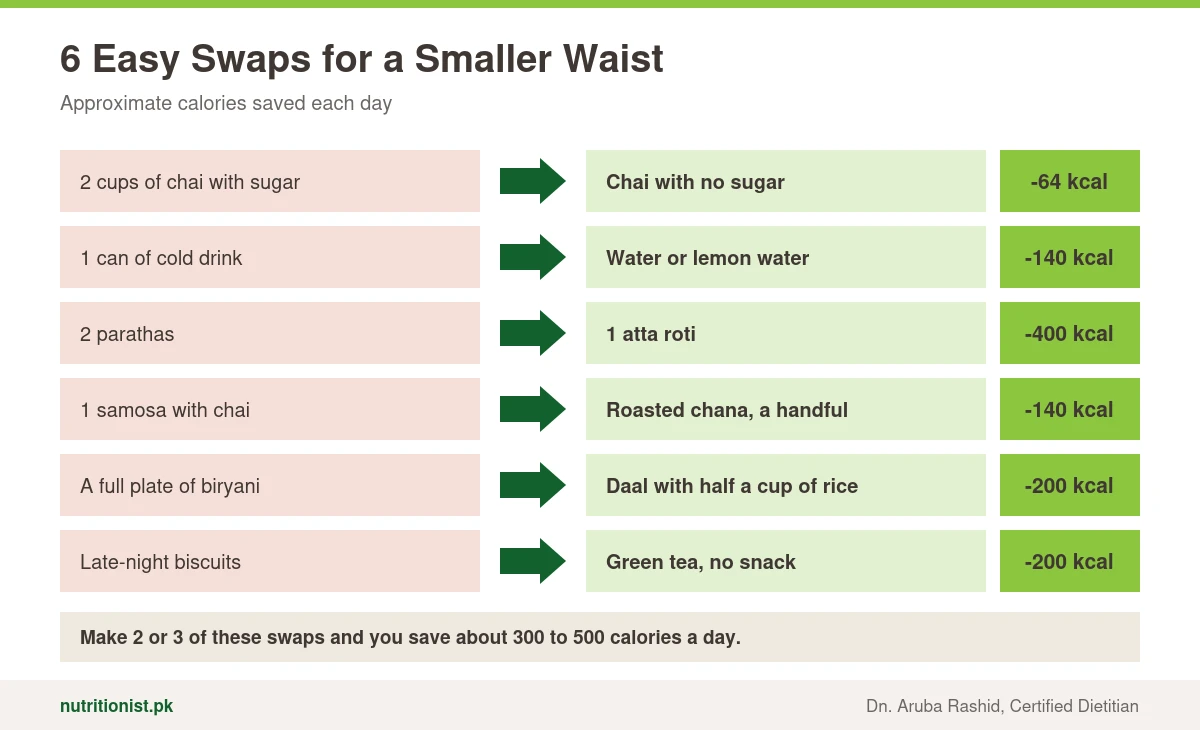
Eat about 300 to 500 calories less than your body uses each day. This leads to a steady loss of about 0.5 to 1 kg a week. Find your daily number with our calorie calculator, and see how to build your meals in our calorie deficit diet plan.
2. Cut sugar and sugary drinks first
This is the single biggest change for most Pakistanis. Two cups of chai with 2 teaspoons of sugar each add about 64 calories of sugar a day, and one can of cold drink adds about 140. Cut sugar in chai to half, then to none, and replace cold drinks and juices with water, lemon water or lassi without sugar.
3. Control roti and rice portions
You do not have to give up roti or rice. Have 1 roti instead of 2 or 3, or half a cup of rice instead of a full plate, and fill the rest of your plate with sabzi and salad. Choose atta roti over naan, paratha and white bread.
4. Eat protein with every meal
Protein keeps you full for longer and protects your muscles while you lose fat. Good Pakistani sources are eggs, chicken, fish, daal, chana, lobia, dahi and paneer. Our high protein breakfast ideas are an easy place to start.
5. Fill half your plate with fibre
Sabzi, salad, fruit, daal, chana and oats are high in fibre, which keeps you full and helps control blood sugar. Aim for at least 2 servings of sabzi and 2 fruits a day.
6. Use less oil and ghee
A typical salan can have 4 to 6 tablespoons of oil, which adds 500 to 700 calories to the pot. Cook with 1 to 2 tablespoons for the whole family dish, and skip the extra tarka. Grill, bake or air fry instead of deep frying.
7. Cut fried snacks and bakery items
Samosa, pakora, nimko, biscuits, rusk, cake and patties are high in calories and easy to overeat. Keep them for occasional treats, not daily tea time. Swap them for roasted chana, fruit, a handful of nuts or a cup of dahi.
8. Walk every day
Walking is the easiest exercise for most people. Start with 20 minutes a day and build up to 30 to 45 minutes, or 7,000 to 10,000 steps. A 10-minute walk after lunch and dinner also helps control blood sugar.
9. Add strength training 2 to 3 times a week
Squats, push-ups, lunges and planks at home, or weights at a gym, help you keep muscle while losing fat. More muscle means your body burns more calories, even at rest.
10. Sleep 7 to 8 hours
Short sleep increases hunger and cravings for sweet and fried food. Try to sleep and wake at the same time every day, and keep your phone away for 30 minutes before bed.
11. Manage stress
Long-term stress makes it harder to lose belly fat and easier to eat for comfort. A daily walk, prayer, deep breathing or time with family can all help.
12. Try an eating window if it suits you
Some people find it easier to eat less when they eat within a fixed time window, such as 12 noon to 8 pm. It is not magic, but it can help you cut late-night snacking. Read our intermittent fasting diet plan to see if it fits your routine.
Want a Diet Plan Made Just for You?
General plans are a good start, but your body, routine and health are unique. Dn. Aruba Rashid, certified dietitian, can create a personal plan for you online, anywhere in Pakistan.
Foods That Help vs Foods That Add Belly Fat
| Eat more | Eat less |
|---|---|
| Eggs, chicken, fish, daal and chana | Sweet chai, cold drinks and packaged juices |
| Sabzi such as palak, lauki, tori, bhindi and gobi | Naan, paratha, white bread and bakery items |
| Salad: cucumber, tomato, onion, salad leaves | Fried snacks: samosa, pakora, nimko, chips |
| Dahi, lassi without sugar, raita | Mithai, halwa, cake and biscuits |
| Fruit such as guava, apple, orange and papaya | Biryani, pulao and heavy oily salan, daily |
| Oats, daliya and atta roti in small portions | Fast food: burgers, pizza, fries and shawarma |
| Water, green tea and lemon water without sugar | Late-night eating and large dinners |
7-Day Pakistani Diet Plan to Lose Belly Fat
This plan gives roughly 1,400 to 1,600 calories a day, which suits most adults trying to lose fat. Men and active people may need 1,800 to 2,000; ask a dietitian if you are not sure. Use 1 to 2 teaspoons of oil per serving, and drink 8 to 10 glasses of water a day.
| Day | Breakfast | Lunch | Evening snack | Dinner |
|---|---|---|---|---|
| Day 1 | 2-egg omelette with sabzi, 1 roti | Chicken salan (less oil), 1 roti, salad | 1 apple, chai with no sugar | Masoor daal, sabzi, salad |
| Day 2 | Oats with milk and a few nuts | Chana pulao (half a cup), raita, salad | Roasted chana | Grilled fish or chicken tikka, salad |
| Day 3 | Besan chilla (2 small), 1 cup dahi | Lauki gosht, 1 roti, salad | 1 guava | Mixed sabzi, 1 roti |
| Day 4 | 2 boiled eggs, 1 brown bread slice | Daal chawal (half a cup of rice), salad | Green tea, 10 almonds | Chicken karahi (less oil), salad |
| Day 5 | Daliya with milk, 1 boiled egg | Palak chicken, 1 roti, salad | 1 cup dahi with cucumber | Lobia, 1 roti, salad |
| Day 6 | Egg bhurji, 1 roti, cucumber | Fish curry, half a cup of rice, salad | 1 orange | Chicken soup with sabzi |
| Day 7 | Chana chaat with 1 boiled egg | Chicken biryani (1 small cup), raita, salad | Chai with no sugar, 1 pear | Daal, tori sabzi, 1 roti |
Check the calories in your own meals with our Pakistani food calorie calculator. For a plan written for men, see our weight loss diet plan for men, and for women, our weight loss diet plan for females.
Simple Home Exercises for a Smaller Waist
Exercise will not burn belly fat by itself, but together with your diet it speeds up fat loss and strengthens your core. Do this routine 3 times a week:
- Brisk walk: 30 minutes, on all 7 days.
- Squats: 3 sets of 10 to 15.
- Wall or knee push-ups: 3 sets of 8 to 12.
- Lunges: 3 sets of 10 on each leg.
- Plank: 3 times, holding for 20 to 40 seconds.
- Glute bridge: 3 sets of 12 to 15.
If you have back pain, knee problems, heart disease or high blood pressure, or have recently had a baby or surgery, check with your doctor before starting new exercises.
Belly Fat After Pregnancy
Many women notice that their belly stays larger after delivery. Some of this is extra fat, and sometimes it is because the stomach muscles have separated (diastasis recti). Wait until your doctor or gynaecologist clears you for exercise, usually around 6 weeks after a normal delivery and longer after a C-section. If you are breastfeeding, avoid strict diets and eat enough to keep your milk supply up; a slow, steady loss is safer.
How Long Does It Take to Lose Belly Fat?
Most people see their waist start to shrink within 3 to 4 weeks of changing their diet and walking daily. With a steady loss of 0.5 to 1 kg a week, many people lose 3 to 5 cm from their waist in 2 to 3 months. The more you have to lose, the faster the early changes usually are.
Be careful of anything that promises a flat stomach in 7 days. Slimming teas, belly belts, fat burner pills and “detox” drinks do not burn belly fat, and some can be harmful.
If you have hypothyroidism, see our thyroid diet plan for how to manage your weight alongside your medicine.
Frequently Asked Questions
What is the fastest way to lose belly fat?
There is no shortcut, but the quickest healthy way is to combine a small calorie deficit with less sugar, smaller roti and rice portions, more protein and a daily walk. Most people see their waist start to shrink within 3 to 4 weeks.
Can I lose belly fat in 7 days?
Not really. You may lose 1 to 2 kg in the first week, but much of that is water and less food in the gut. Real fat loss is slower, about 0.5 to 1 kg a week. Avoid anything that promises a flat stomach in a week.
Which drink burns belly fat?
No drink burns belly fat on its own, including green tea, lemon water, jeera water or cinnamon water. What helps is replacing sugary drinks such as sweet chai, cold drinks and juices with water or unsweetened drinks, which cuts hundreds of calories a week.
Do sit-ups and crunches reduce belly fat?
They strengthen your stomach muscles, but they do not burn the fat on top of them. To lose belly fat you need to lose fat overall through diet and activity. Strong core muscles will show more once the fat comes off.
What waist size is healthy for Pakistanis?
For South Asians, a waist of 90 cm (35.4 inches) or more in men and 80 cm (31.5 inches) or more in women means central obesity and higher health risk. Aim to keep your waist below these numbers.
Why do I have a big belly but thin arms and legs?
This is common in South Asians and usually means fat is stored around the organs. It carries a higher risk of diabetes and heart disease even if your weight looks normal. A diet with less sugar and refined carbs, plus daily walking and strength training, helps most.
Should I get any tests if I have a lot of belly fat?
It is a good idea to ask your doctor about checking your blood sugar (HbA1c or fasting sugar), cholesterol, blood pressure and liver function, especially if your waist is above the healthy limit or diabetes runs in your family.
Get a Personal Belly Fat Diet Plan
A plan made for your body, routine and health reports works better than a general chart. Dn. Aruba Rashid, a certified dietitian, creates personal diet plans with Pakistani food for belly fat, weight loss, PCOS, diabetes and fatty liver. She consults online across Pakistan on WhatsApp, and sees women in person in Multan.