Intermittent Fasting Diet Plan: 16:8 Pakistani Meal Plan for Beginners
Intermittent fasting is one of the most popular ways to lose weight in Pakistan right now, and for good reason: it does not ban roti, rice or desi food. It simply changes when you eat. This intermittent fasting diet plan explains how it works, whether it really helps with weight loss, who should not try it, and how to follow the 16:8 method with Pakistani food, including a 7-day meal plan you can start this week.
Written by Dn. Aruba Rashid, certified dietitian (BS Human Nutrition and Dietetics). Updated October 2026.
Key takeaways
- Intermittent fasting means eating within a fixed daily window; with 16:8 you fast for 16 hours, including sleep, and eat within 8.
- A 2026 Cochrane review found intermittent fasting gives about the same weight loss as a normal calorie-controlled diet.
- Water, black tea, green tea and black coffee without sugar are fine during the fast; chai with milk or sugar breaks it.
- Open your fast with protein, and keep a balanced plate: half sabzi, a quarter protein and a quarter roti or rice.
- Speak to your doctor first if you are pregnant, breastfeeding, underweight or take diabetes medicines.
What Is Intermittent Fasting?
Intermittent fasting (IF) means eating all your food within a fixed time window each day, and eating nothing in the hours outside it. It is not a diet that tells you which foods to eat. It is a schedule that tells you when to eat.
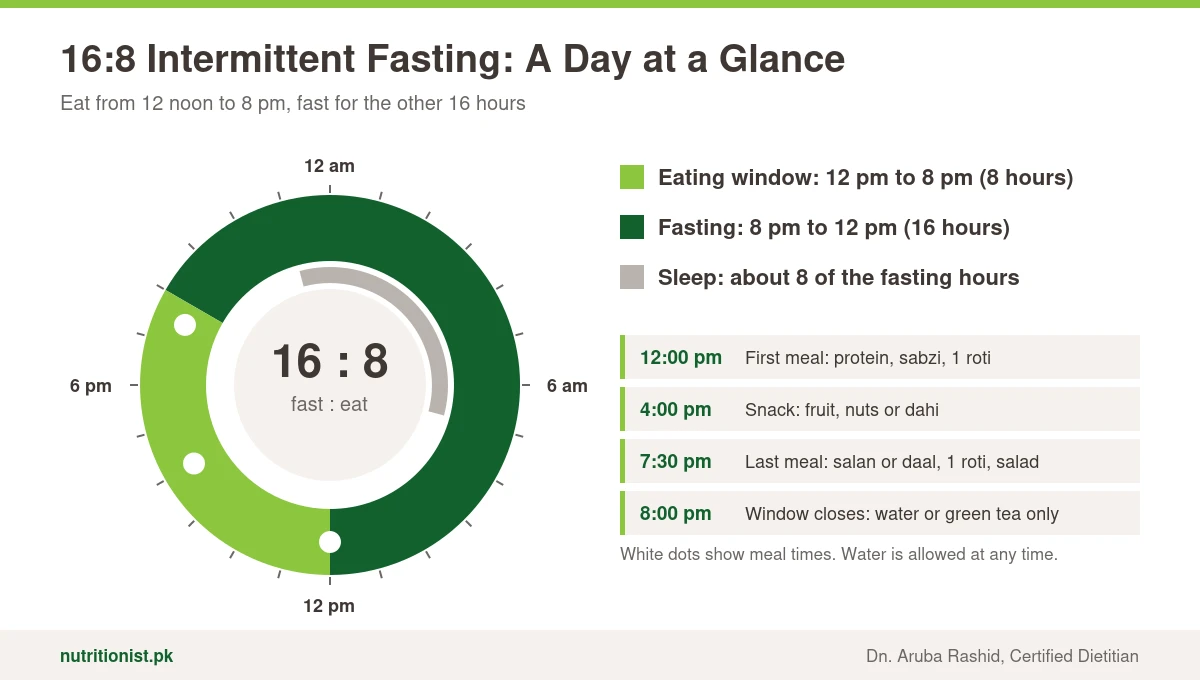
The most popular method is 16:8. You fast for 16 hours, including the time you sleep, and eat within an 8-hour window, for example from 12 noon to 8 pm. Most people find it easier than it sounds, because 8 of those 16 hours pass while sleeping.
Types of Intermittent Fasting
| Method | How it works | Best for |
|---|---|---|
| 12:12 | Eat within 12 hours, for example 8 am to 8 pm | Complete beginners, the first week |
| 14:10 | Eat within 10 hours, for example 10 am to 8 pm | Women, and anyone who finds 16:8 hard |
| 16:8 | Eat within 8 hours, for example 12 noon to 8 pm | Most adults who want to lose weight |
| 18:6 | Eat within 6 hours, for example 1 pm to 7 pm | People already comfortable with 16:8 |
| 5:2 | Eat normally 5 days, about 500 to 600 calories on 2 days | People who prefer fasting on fixed days |
| OMAD (one meal a day) | One meal in 24 hours | Not recommended; hard to get enough nutrition |
If you are new to fasting, start with 12:12 or 14:10 and move to 16:8 over two to three weeks. There is no need to go beyond 16:8 to lose weight.
Does Intermittent Fasting Work for Weight Loss?
Yes, but not because of magic hormones. Intermittent fasting works mainly because a shorter eating window means fewer meals, fewer snacks and fewer cups of sweet chai, so you eat fewer calories overall. If you eat a lot more within your window, you will not lose weight.
A Cochrane review published in 2026 looked at 22 randomised trials with almost 2,000 people. It found that intermittent fasting led to about the same weight loss as normal calorie-controlled dieting, with no extra safety problems. In simple words: intermittent fasting is not better than a regular diet, but it is a good option if you find it easier to follow. (Source: Rutgers Health, on the Cochrane review)
For most people, losing 0.5 to 1 kg a week is a realistic and healthy pace. To see how many calories you need, use our TDEE calculator, then aim for about 300 to 500 calories less than that number inside your eating window.
Intermittent Fasting vs Ramadan Fasting
Ramadan roza and intermittent fasting both have long gaps without food, but they are not the same. In Ramadan you also stop drinking water, and the fast follows sunrise and sunset. With intermittent fasting you can drink water, black tea and black coffee during the fast, and you choose your own window.
Many people in Pakistan lose weight in Ramadan and gain it back after Eid, because iftar and sehri become heavy, fried meals. The same rule applies to both: what you eat when you open your fast matters as much as the fast itself. See our Ramadan diet plan for healthy sehri and iftar ideas.
Who Should Not Try Intermittent Fasting
Intermittent fasting is safe for most healthy adults, but it is not for everyone. Do not start it without speaking to your doctor if you:
- Are pregnant, trying to get pregnant, or breastfeeding.
- Have type 1 diabetes, or type 2 diabetes treated with insulin or tablets such as gliclazide or glimepiride, because your sugar can drop too low.
- Take medicines that must be taken with food, or medicines for blood pressure or heart disease.
- Are underweight, or have a history of an eating disorder.
- Have frequent acidity, stomach ulcers or gastritis that gets worse when you skip meals.
- Are under 18 or over 70.
If you have diabetes, follow our diabetes diet chart and let your doctor decide whether fasting is safe with your medicines.
How to Start Intermittent Fasting: Step by Step
- Week 1: Stop eating after dinner and do not snack late at night. Keep a 12-hour gap, for example 8 pm to 8 am.
- Week 2: Push breakfast later by an hour or two to reach 14:10, for example 10 am to 8 pm.
- Week 3: Move to 16:8 if you feel well, for example 12 noon to 8 pm.
- Every day: Drink 8 to 10 glasses of water, mostly during the fasting hours, and keep your sleep timings regular.
- Pick a window that fits your life: office workers often prefer 12 noon to 8 pm, and people who need breakfast can use 9 am to 5 pm.
Feeling a little hungry for the first few days is normal. Feeling dizzy, shaky, very weak or getting headaches that do not settle is not. If that happens, eat something and shorten your fasting time.
What You Can Drink During the Fast
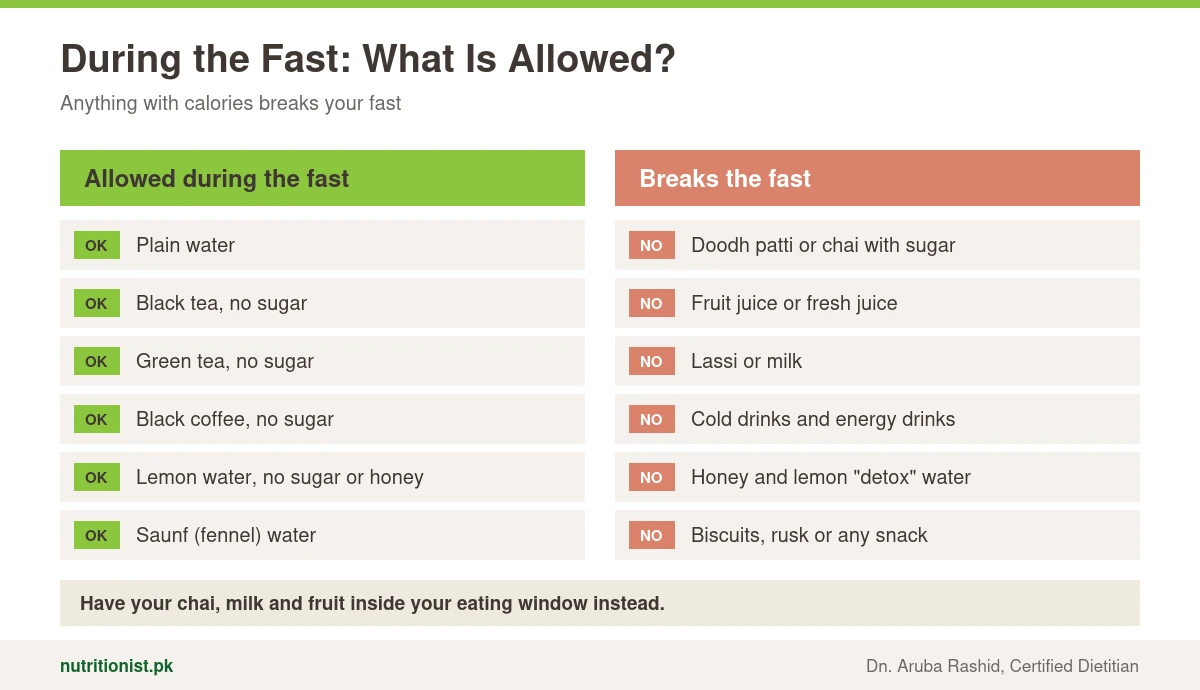
Anything with calories breaks your fast. During the fasting hours, stick to:
- Plain water, as much as you like.
- Black tea or green tea, with no sugar and no milk.
- Black coffee, with no sugar.
- Plain water with a squeeze of lemon, or saunf (fennel) water, without sugar or honey.
Doodh patti, chai with sugar, juices, lassi, soft drinks and “detox” drinks with honey all break the fast. Have your chai inside your eating window, with less sugar or none.
What to Eat in Your Eating Window
Intermittent fasting is not a licence to eat anything. Make each meal a balanced Pakistani plate:
- Half the plate: sabzi or salad, such as palak, lauki, tori, bhindi, gobi, cucumber and tomato.
- A quarter: protein, such as eggs, chicken, fish, daal, chana, dahi or paneer.
- A quarter: carbs, such as 1 medium atta roti or half a cup of rice.
- A little fat: 1 to 2 teaspoons of oil or ghee per serving of salan.
Open your fast with protein, not with paratha, samosa or mithai. A high protein first meal keeps you full until your next meal. Our high protein breakfast ideas work well as a first meal, even at 12 noon.
Want a Diet Plan Made Just for You?
General plans are a good start, but your body, routine and health are unique. Dn. Aruba Rashid, certified dietitian, can create a personal plan for you online, anywhere in Pakistan.
7-Day Pakistani Intermittent Fasting Meal Plan (16:8)
This plan uses a 12 noon to 8 pm window, with two meals and one snack. It gives roughly 1,400 to 1,700 calories a day, which suits most adults who want to lose weight. Women who are smaller or less active may need a little less, and men or very active people a little more.
| Day | First meal (12 pm) | Snack (4 pm) | Last meal (7:30 pm) |
|---|---|---|---|
| Day 1 | 2-egg omelette with onion and tomato, 1 roti, cucumber | 1 cup chai with no sugar, 1 apple | Chicken salan (less oil), 1 roti, salad |
| Day 2 | Besan chilla (2 small) with mint chutney, 1 cup dahi | 10 almonds, green tea | Masoor daal, half a cup of rice, sabzi |
| Day 3 | 2 boiled eggs, 1 roti, cucumber and tomato | 1 guava or orange | Grilled fish or chicken tikka, raita, salad |
| Day 4 | Oats cooked in milk with a few nuts, 1 boiled egg | Roasted chana (a handful) | Palak paneer, 1 roti, salad |
| Day 5 | Chicken sandwich with brown bread and salad | 1 cup dahi with cucumber | Lauki chana daal, 1 roti |
| Day 6 | Egg bhurji with 1 roti, 1 cup lassi without sugar | 1 banana or 1 pear | Chicken karahi (less oil), 1 roti, salad |
| Day 7 | Chana chaat with onion, tomato and lemon, 1 boiled egg | Green tea, 5 walnut halves | Mixed sabzi, daal, 1 roti |
To check the calories in your own meals, use our Pakistani food calorie calculator. If your weight does not change after three to four weeks, reduce portions slightly or add a daily 30-minute walk.
Intermittent Fasting for Women and PCOS
Many women do well with intermittent fasting, but some find that long fasts affect their energy, sleep or periods. For women, 14:10 is often a better place to start than 16:8. If your periods become irregular, or you feel very tired, shorten your fasting window or stop.
Some small studies suggest intermittent fasting may help with weight and insulin resistance in PCOS, but the evidence is still limited. Weight loss of even 5% can improve PCOS symptoms, whichever method you use. See our PCOS diet plan for foods that help, and speak to your gynaecologist before fasting if you are trying to conceive.
Common Intermittent Fasting Mistakes
- Overeating in the window: eating a large plate of biryani, mithai and cold drinks when you open your fast cancels out the fasting hours.
- Too little protein: without eggs, daal, chicken or dahi, you feel hungrier and can lose muscle.
- Not drinking enough water: thirst often feels like hunger, and low water intake causes headaches.
- Going too long too fast: jumping straight to 18 or 20 hours makes most people give up within a week.
- Sweet chai during the fast: even one cup of chai with milk and sugar breaks the fast.
- Late-night snacking: eating after your window closes is the most common reason people do not see results.
Track Your Progress
Weigh yourself once a week, at the same time of day, rather than every morning. Measure your waist once a month too, because fat loss around the waist matters more for health than the number on the scale. Our BMI calculator and body fat calculator can help you see where you stand.
If intermittent fasting does not suit you, a simple calorie deficit diet plan gives the same results without long gaps between meals. For a very low carb approach, compare it with our keto diet plan.
For more ways to trim your waist, read our guide on how to lose belly fat.
Frequently Asked Questions
How much weight can I lose with intermittent fasting in a month?
Most people lose about 2 to 4 kg in the first month if they stay within their calories, and part of the early loss is water. After that, 0.5 to 1 kg a week is a healthy pace. Results depend on what you eat in your eating window, not just on fasting.
Can I drink chai during intermittent fasting?
Not during the fasting hours if it has milk or sugar, because that breaks the fast. Black tea or green tea without sugar is fine. Have your doodh patti inside your eating window, ideally with less sugar or none.
Is 16:8 intermittent fasting safe every day?
For most healthy adults, yes. Many people follow 16:8 every day for months. If you have diabetes, take regular medicines, are pregnant or breastfeeding, or have a history of an eating disorder, speak to your doctor first.
What is the best time window for intermittent fasting in Pakistan?
12 noon to 8 pm suits most people because it covers lunch and dinner with the family. If you need breakfast before work or college, 9 am to 5 pm or 10 am to 6 pm also works. The best window is the one you can keep every day.
Can women with PCOS do intermittent fasting?
Many can, and losing weight often improves PCOS symptoms. Start with a gentler 14:10 window, eat enough protein, and stop or shorten the fast if your periods become irregular. Speak to your gynaecologist first if you are trying to get pregnant.
Is intermittent fasting better than a normal diet?
Research shows it gives about the same weight loss as a normal calorie-controlled diet. It is not better, but some people find it easier because there are fewer meals to plan. Choose the approach you can follow for months, not weeks.
Can I do intermittent fasting with diabetes?
Only with your doctor’s guidance. If you take insulin or tablets such as gliclazide or glimepiride, fasting can make your blood sugar drop too low. Your doctor may need to change your medicine timings or doses before you start.
Get a Personal Intermittent Fasting Plan
Intermittent fasting works best when your eating window, meals and portions are planned around your routine, health and reports. Dn. Aruba Rashid, a certified dietitian, creates personal diet plans with Pakistani food, including intermittent fasting plans, and checks whether fasting is safe for you first. She consults online across Pakistan on WhatsApp, and sees women in person in Multan.